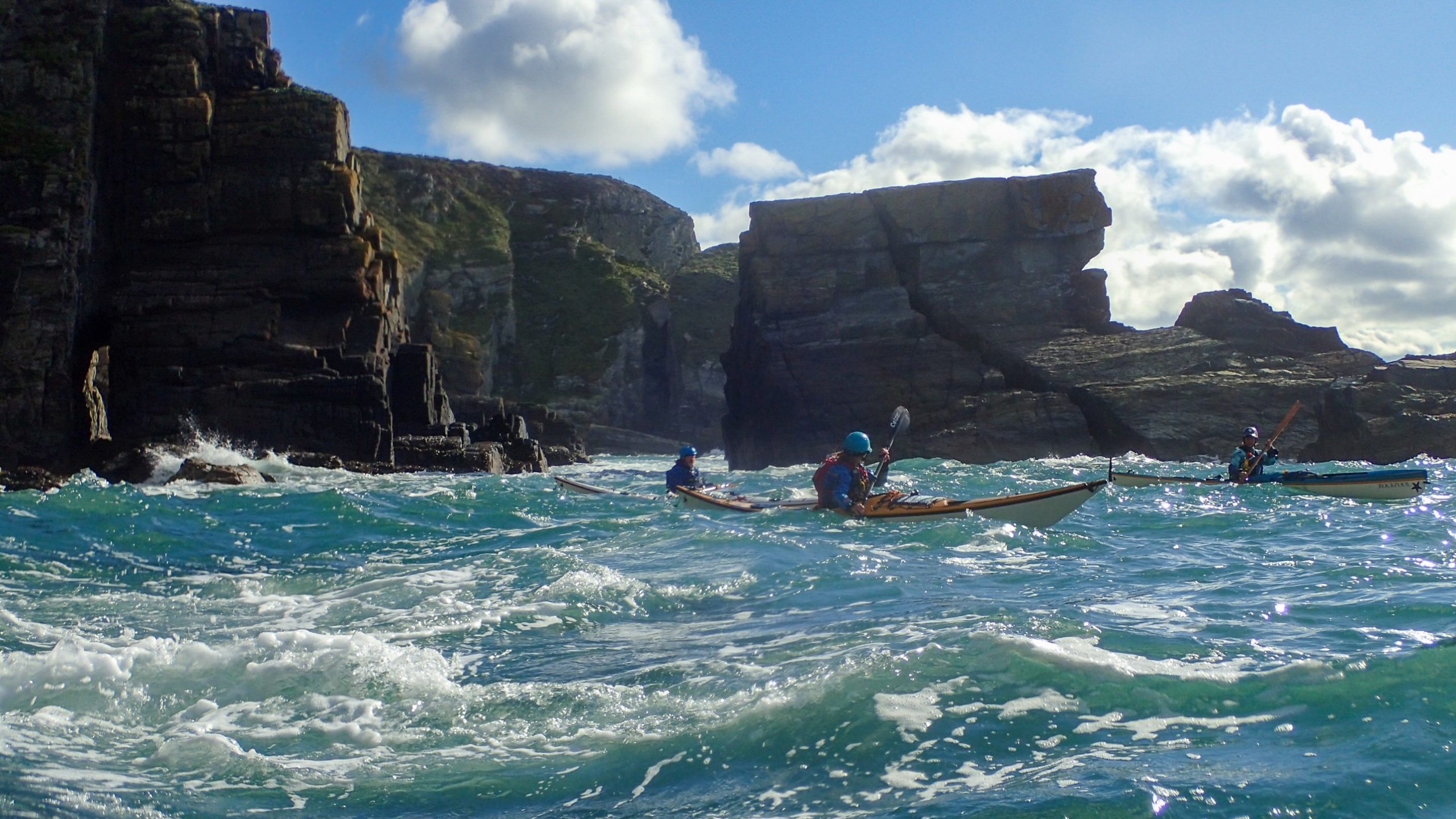
Every expedition we run carries a grade from 2 to 4 stars. The grade tells you what the sea is likely to ask of you on the trip, and what you should already be able to do before you join us.
Where the stars come from
The star grades come from the British Canoe Union’s old star awards, which for decades were the common language of sea kayaking in Britain and far beyond. The British body, now called Paddle UK, has since replaced the stars with three personal awards: the Sea Kayak Award, the Coastal Sea Kayak Award and the Advanced Sea Kayak Award. Most experienced paddlers still describe themselves in stars, so we use them too.
You don’t need a certificate to join us. What matters is whether you can paddle comfortably in the conditions a grade describes. If you hold an award from Paddle UK, Canoeing Ireland, the Norwegian Paddling Federation or another national body, tell us when you book and we’ll help you match it to our grades.
The grades at a glance
| 2 star | 3 star | 4 star | |
|---|---|---|---|
| Water | Sheltered | Moderate | Advanced |
| Wind | Up to force 3 | Up to force 4 | Above force 4 |
| Waves at sea | Around 0.6 m | Around 1 m, up to 1.5 m | 2 m and more |
| Tide | Weak or none | Up to 2 knots, no tide races or overfalls | Tide races and overfalls you can’t always avoid |
| Surf landings | None | Up to 1 m | Up to 1.5 m |
| Crossings and landings | Close to shore, with easy landings | Crossings up to 2 nautical miles, with landings no more than 2 nautical miles apart | Open crossings; on some stretches landing is difficult or impossible |
| Equivalent award | Paddle Discover / Explore, old 2 star | Sea Kayak Award, old 3 star | Coastal and Advanced Sea Kayak Awards, old 4 star |
| Our trips | Hamarøy | Værøy, Helgeland | Sørøya, Raz de Sein, Musandam |
2 star – sheltered water
You’ve paddled a sea kayak before and you’re comfortable in it. You can paddle in a straight line, turn the boat when you want to, and stay relaxed in a light to gentle breeze. We stay close to shore, where landing is easy.
- You can paddle 15–20 km in a day without exhausting yourself
- You can steer and turn the kayak with your strokes
- You can do a wet exit, and you know how to be rescued by others
Hamarøy is graded 2 star because we coach you through the tide races step by step. It’s a good first expedition and a natural step towards our 3 star trips.
3 star – moderate water
You’re a confident sea paddler on open coasts. You’ll meet a moderate breeze, a slight to moderate sea, tidal streams up to 2 knots, and launches and landings through small surf.
- You can paddle 20–30 km a day, several days in a row
- You can hold your course in wind and waves from any direction
- You can do assisted rescues quickly and calmly. A roll is a strong advantage
- You can launch and land through surf up to about 1 metre
4 star – advanced water
Our most committing trips. They include fresh winds, rough seas, tide races and overfalls that can’t always be avoided, long open crossings and stretches of coast with nowhere to land. On the Raz de Sein the tide runs at up to six knots.
- You can paddle 30 km or more a day in rough water
- You have a reliable roll and can rescue others in rough water
- You’re comfortable in clapotis, tide races and surf up to 1.5 metres
- You have experience of multi-day journeys on exposed coasts
Reading the wind: the Beaufort scale
Norwegian forecasts on yr.no give wind in metres per second. This table shows how that converts to the Beaufort forces used in our grades, and what the sea typically looks like.
| Force | Description | m/s | Knots | Probable wave height | Probable maximum | Sea state |
|---|---|---|---|---|---|---|
| 1 | Light air | 0.3–1.5 | 1–3 | 0.1 m | 0.1 m | Calm, rippled |
| 2 | Light breeze | 1.6–3.3 | 4–6 | 0.2 m | 0.3 m | Smooth, wavelets |
| 3 | Gentle breeze | 3.4–5.4 | 7–10 | 0.6 m | 1.0 m | Slight |
| 4 | Moderate breeze | 5.5–7.9 | 11–16 | 1.0 m | 1.5 m | Slight to moderate |
| 5 | Fresh breeze | 8.0–10.7 | 17–21 | 2.0 m | 2.5 m | Moderate |
| 6 | Strong breeze | 10.8–13.8 | 22–27 | 3.0 m | 4.0 m | Rough |
Not sure which grade you are?
Tell us about your paddling: where you’ve been, in what conditions, and any courses or awards you hold. We’ll give you an honest answer. If you need to build skills before an expedition, our sister company Kajakk Nord runs courses in Norway that will get you there.